Cafe Location Finder
There's a trick for finding good areas when you're traveling in the US.
You look for a Lululemon.
But not just any Lululemon — it has to be a storefront.
So not in a shopping mall, but a standalone, street-facing Lululemon.
This is the idea (and it's simple)...
Lululemon spends enormous amounts of money researching where to open their next store.
They have teams of people whose entire job is location intelligence; so when you find a Lululemon storefront somewhere, you can be confident that the area around it is good: walkable, nice cafes, maybe specialty coffee, gyms & organic grocery stores (lifestyle stuff).
The Lululemon is a signal & you're piggybacking on millions of dollars of someone else's location research.
I used this when traveling through middle-of-nowehere US (Iowa). And it works.
But then I was traveling through Europe - Montenegro, Slovakia, Spain, Germany, France - I needed an equivalent.
So because there's no Lululemon on every corner in Europe, what's the signal here?
The Europe Coffee Trip trick
I found it in an app called Europe Coffee Trip. It maps specialty coffee shops across Europe (not Starbucks or chain stuff but actual specialty coffee). Things like third-wave roasters, single-origin places, the kind of cafe where people care about extraction ratios.
But here's the thing about specialty coffee: it's a gentrification signal.
Where you see clusters of specialty cafes on the map, you can assume a certain level of neighborhood development (like Lululemon - walkable streets, organic stores nearby, yoga studios, good vibes). It's not a perfect indicator, but it's surprisingly reliable. When I was driving through some random part of Europe and I pull up Europe Coffee Trip and see five specialty cafes clustered together in a town I've never heard of, I know that town has something going on.
This worked really well for finding places to stay and areas to explore & honestly, better than any travel guide.
The problem in Tallinn
I'm from Tallinn, Estonia.
And this is just my gut feeling (I can't prove it) but I think most location decisions here work in a way where you find a space that's available, it feels right & then you close your eyes and sign the lease.
Maybe if you're SUUUUPER diligent you drive around the neighborhood a few times. Maybe you count pedestrians for an afternoon. Maybe you ask a friend. But mostly it's gut feel plus whatever happens to be on the market.
And honestly, that makes sense... if you're not a nerd.
But hey, lucky for us!...
For better or for worse Estonia (and the EU) has way too much publicly available data. Even sensitive data, stuff that your competitors can use against you.
But I can't be bothered with that right now (sorry for getting you excited) we'll be using the boring data for this.
Obviously whether a business actually succeeds depends on like a million things - the product, the service, the team, the timing, the pricing, whether you're lucky, whether the government is arresting your customers for standing too close to each other & forcing every to wear a paper with strings over their noses or whether the economy is in the process of collapsing - and then location is honestly just one of those things and probably not even the most important one if we're being real about it.
But it's one of the few things where you can now actually look at real data before you commit to a lease & go "okay so what's actually happening in this neighborhood" instead of just vibing it out and hoping for the best.
The Saiakoda story
I know a guy named François who runs a bakery called Saiakoda. He's a Belgian baker - gets his own organic wheat from Viljandi (which literally translates to something like Wheat-land), mills it himself on-site with a stone mill, uses a wood-fired oven (which is apparently crazy difficult to learn - he said the learning curve for the oven itself takes about a year & that makes hiring like almost impossible... well that and the fact that he sticks to traditional baking which means 3am wakeups). But anyway he's kind of a rare specimen of true mastery in the western world.
In short he makes bread the real way, the ancient way, how we used to make bread. Long fermentation, hand-kneaded, no bs. It's genuinely the healthiest bread I've found when traveling the world and also the best. I'm not just glazing him, just calling it how I see it.
Anyway, François wanted to move to a new location. He mentioned a spot he was looking at in Vana-Kalamaja and I immediately said no.
That's a cursed location.
I've watched that specific address - Vana-Kalamaja 21 - chew through businesses for years. Every few months there's a new place opening up & every few months it shuts down. And it looks great on paper! It's in Kalamaja. The space had a full kitchen from the previous bakery. The rent is reasonable. It's near a pedestrian street. It checks every box.
But it's cursed.
It's dark. It doesn't feel inviting. It's slightly off to the wrong side of the road. There's this weird energy where you walk past it and don't even register it's there - the vibe is just off. Feels underground (not in a cool way). Feels dirty. Nobody wants to go there & every business that has tried to make it work has learned this the hard way.
So I thought... okay, let me actually try to help figure out the right location. Like actually take this seriously for once instead of just having opinions about it.
So I built the thing
So the question became like... how do you actually research a location in 2026?
You have AI now, all this open data I just mentioned, EMTA and the Business Registry and Statistics Estonia with population grids and Maa-amet with geocoding APIs - actual real numbers on how much money your competitors are making, how many people live within walking distance, what the demographics look like. Real data, not vibes.
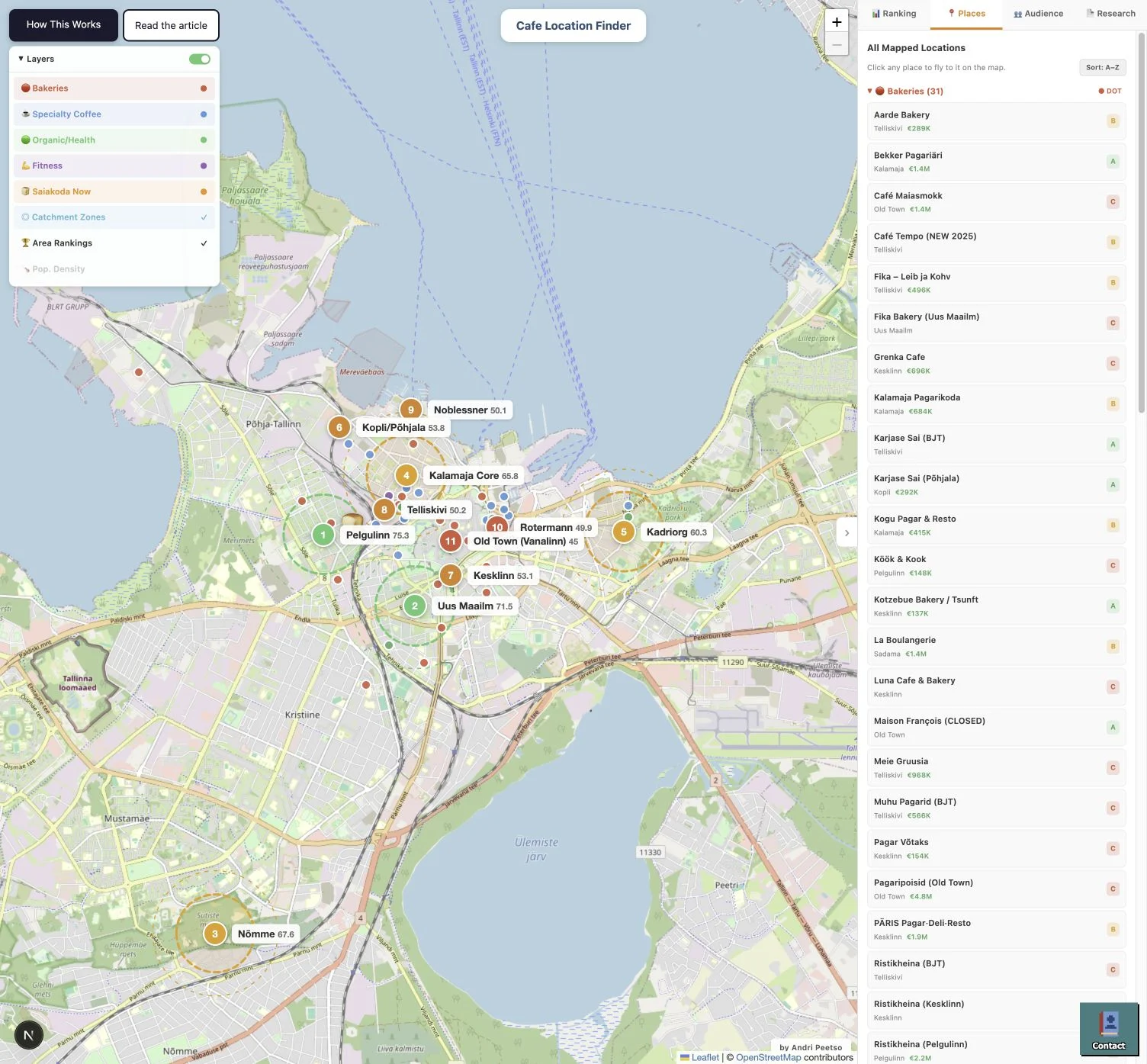
So I built this location intelligence tool (I don't know what else to call it). It's an interactive dashboard that combines a map of Tallinn with everything I could get my hands on:
Competitors - every artisan bakery, specialty coffee shop, organic store & fitness studio I could find, plotted on the map with estimated revenues pulled from EMTA. Not random pins; each one tells you something about who lives & moves through that area (and how much money is being made there, which is honestly the most interesting part).
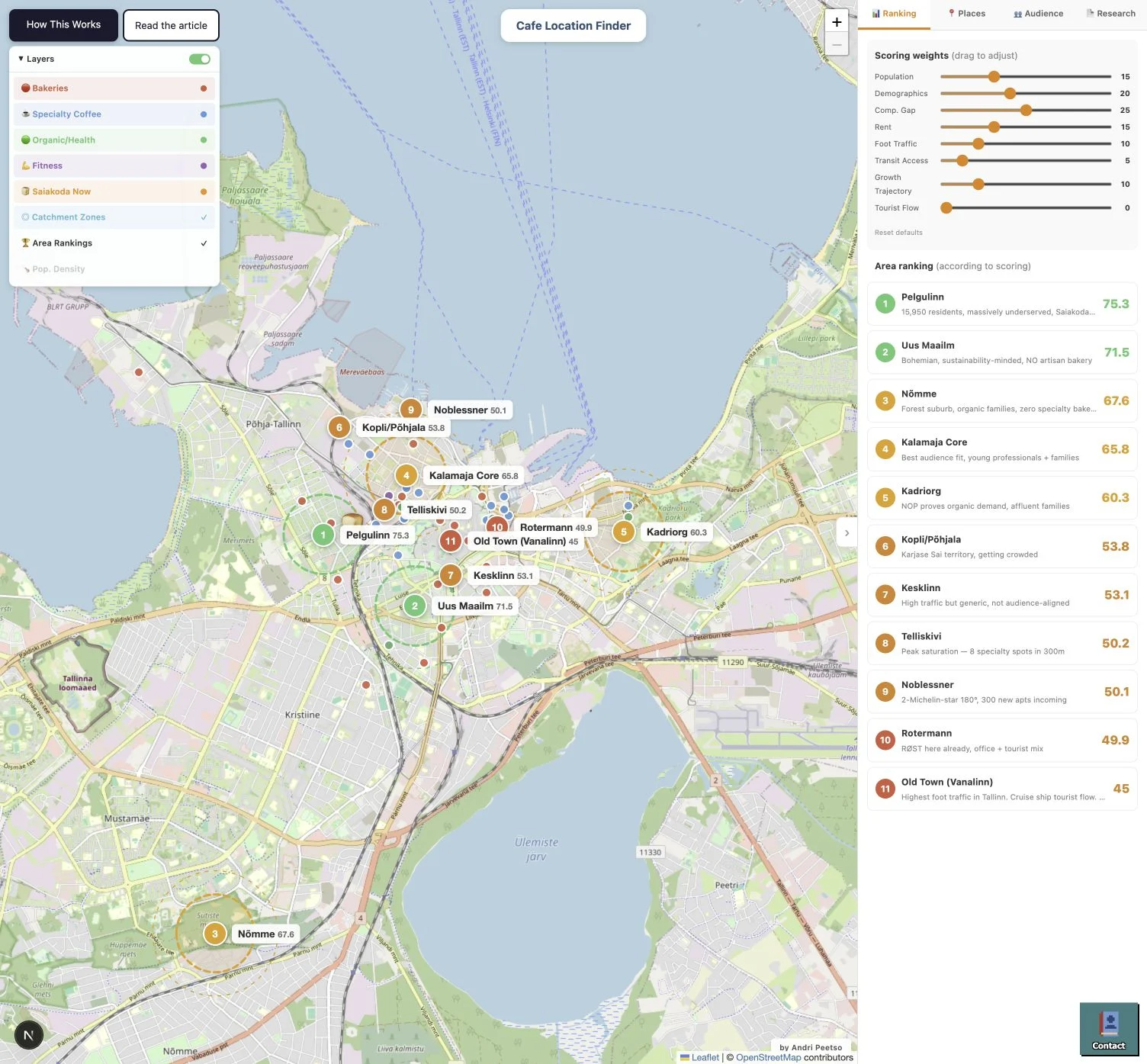
Neighborhood scoring - the current demo compares 11 candidate neighborhoods, with adjustable weights for population density, demographic fit, competition gap, rent efficiency, foot traffic, transit accessibility, growth trajectory & tourist flow. If you disagree with how I weighted things you can just drag the slider & the rankings recalculate in real time. Which I think is important because honestly my weighting is probably wrong in some ways and I just don't know which ways.
Real estate listings - actual available commercial spaces with rents and sizes and whether they have a kitchen already & direct links to the listings so you can actually go look at them.
Revenue channels - this one is important because a daily bakery-café isn't a Saturday pre-order operation. 90% of revenue comes from people who've never heard of François - morning commuters grabbing a croissant, lunch crowds, afternoon coffee people, weekend families on a brunch trip, Wolt delivery orders. The loyal pre-order crowd from Härjapea follows him anywhere but they're maybe 5% of daily revenue & basically irrelevant to where you should actually open (counterintuitive because those are the customers you know and talk to, but they're just not the ones that determine whether a location works).
Methodology - Huff gravity model for distance decay, trade area analysis with walking radii, saturation ratios, rent-to-revenue rules. All visible & toggleable so you can see exactly why the model thinks what it thinks. Whether any of this is actually correct is a different question entirely but at least you can see the reasoning.
Macro vs micro
So here's what I realized building this...
The tool above is a macro tool. It answers the macro question - which neighborhood should you be in. Population density, competition gaps, rent efficiency, transit access, demographic fit. That's the spreadsheet question & the tool handles it pretty well (I think).
But there's a second question the tool just straight up can't answer and it's honestly the more important one: the micro question. Which specific address within that neighborhood. Which side of the street. Which floor. Which door. This is where most people get destroyed because the macro can be absolutely perfect and the micro can still kill you.
Vana-Kalamaja 21 scored perfectly in the macro model. Kitchen-ready, Kalamaja address, reasonable rent, decent foot traffic numbers. The spreadsheet said go. But anyone who's actually walked past that spot and paid attention knows it will eat you alive.
One corner of Rotermann can be golden and the other corner - literally across the same street - is dead. There's a spot near Rotermanni with huge foot traffic & a massive commercial space, backed by actual public company money and actually good coffee - and you'd think that sounds amazing right? It's mostly dead (or maybe it just feels like it cause it's so big idk). Most people walk past and just don't stop. Meanwhile a cafe around the corner (Röst) is packed every single day and while yes it has better macro (foot traffic from the ships) I honestly still don't fully understand why except that the micro is just better there somehow. Better vibes I guess.
The tool can't tell you why, probably only vibes can. So perhaps all this data analysis is useless and you can still get it wrong if you pick the wrong specific spot with bad juju.
So idk use the tool to enforce a hierarchy: fatal flaw gate first (if a location has a fatal flaw it's done, I don't care what the data says), then site visit score (you actually go there and look at stuff with your eyes like a normal person), then data score (the neighborhood model). A listing that scores 95 out of 100 on data but has a single fatal flaw? Crossed out. No override.
The macro gets you to the neighborhood.
The micro gets you the spot.
How to pick the micro
So the macro question has a right answer you can calculate (or at least try to calculate, and probably get close enough).
The micro question has a right answer you can only feel - but I think you can train yourself to feel it more systematically if you know what to pay attention to instead of just walking around going "yeah this feels nice" or whatever. Here's what I'd look for (not the definitive list, just what I've noticed matters).
Visibility & discovery
The single most important micro factor is probably this (sounds obvious when you say it out loud but almost nobody actually checks it):
Can someone walking by see you, understand what you are, and decide to walk in - all within about three seconds?
I call it the three-second test (not an original name but whatever, it's descriptive). If you fail it, nothing else matters. You can have the best bread in the city & the best rent deal & the best neighborhood score and if people walk past your door without registering you exist you're just dead. Doesn't matter how good your sourdough is if nobody knows you're there.
Vana-Kalamaja 21 fails this completely. It's technically on a decent street but the entrance is recessed and slightly below eye level & your gaze just slides right past it. You have to already know it's there to find it. For a bakery where 90% of daily revenue comes from people who've never heard of you and are just walking past... that's fatal.
Ground floor is mandatory. Every step below or above street level costs you customers - not a few, a lot. A basement café needs to be dramatically better than a street-level competitor just to break even on the foot traffic it's losing by being underground (and most aren't, they're just the same café but harder to find). Second floor is even worse unless you're a destination restaurant with a reservation list and a following, which a daily bakery is not and probably never will be.
Signage matters way more than people think and I didn't appreciate this until I started paying attention. Can you put a sign that's visible from 30 meters away? Not a little plaque next to the door that you can only read when you're already standing in front of it - an actual sign that someone walking down the street can read before they reach your entrance and go "oh that's a bakery, that looks good." Some landlords restrict signage and some buildings have heritage protection rules in Tallinn (understandable but still annoying). Check this before you sign anything because if you can't put up a proper sign you're basically invisible.
Sun & weather
Tallinn is at 59.4 degrees north. The sun is low and it's precious & people chase it like crazy - like genuinely if the sun is out in Tallinn everyone loses their minds and goes outside immediately, it's kind of funny actually.
A south-facing terrace with afternoon sun is worth more than almost any other single feature of a location. I genuinely believe this and if you asked any café owner in Tallinn they'd say the same thing (though some might not admit it because it would mean admitting their terrace sucks).
I've seen cafes with mediocre food & mediocre everything pack their terraces every sunny day from April to September simply because they face the right direction. Meanwhile the technically-better café across the street sits in shadow & wonders why nobody's sitting outside. It's the sun dude. It's always been the sun. This is the Nordics.
When you're evaluating a space go there at 2pm on a sunny day. Stand where the terrace would be. Is it in sun? Will it still be in sun at 4pm? Is there a building to the south that's going to throw shadow over everything by mid-afternoon? If you don't check this before signing a lease you're kind of crazy because this alone can make or break a café up here.
Wind corridors are the other weather killer nobody talks about (or at least not when they're signing leases - only after, when it's too late). Modern buildings with gaps between them create wind tunnels & an entrance in one of these corridors just feels miserable - the door is hard to open, terrace furniture blows around, you're sitting there trying to eat a croissant and your napkin flies away and everything is annoying. Walk around the building on a windy day. If there's a spot where the wind accelerates between two buildings you've found a micro flaw no spreadsheet will ever show you.
Rain shelter matters too but people forget about it. An awning, an overhang, some kind of covered area near the entrance. In Tallinn it rains a lot (like a lot a lot, way more than people who haven't lived here would think). If your entrance is fully exposed people won't stand there deciding whether to come in - they'll just keep walking to somewhere dry because why would they stand in the rain debating whether your pastry is worth it.
Threshold resistance
Every single barrier between the street and your counter costs you customers and there's this concept called threshold resistance that I only learned about recently but it explains so much about why some locations work and others don't & most people (including me, before I started actually thinking about this stuff) massively underestimate how much it matters.
Steps down (even one or two!) create resistance. A heavy door that doesn't open easily. A confusing entrance where you can't tell if you're supposed to push or pull or which door is even the right one or whether the place is even open. A long corridor between the street door & the actual café. A courtyard you have to cross. Each of these things is basically a filter that just removes a percentage of potential walk-ins and the annoying thing is you never see those people because they just... walked past and you'll never know they existed.
The best locations have zero threshold resistance and you can feel it when you walk into one. You're walking down the street, you see the counter, you see the pastries, you smell the bread, you walk straight in. No steps, no heavy door, no corridor, no confusion. Street to counter in five seconds. It just flows.
The worst version of this is what I'd call the "hidden gem" problem. Some landlords will sell you on the idea that being tucked away is charming and that people will discover you and that it creates this sense of exclusivity or whatever and this is (in my opinion) basically a lie that landlords tell you to rent spaces that are hard to rent. Or at best it only works for restaurants that can afford to operate on reservations alone because they already have a reputation - which a new bakery doesn't have and won't have for a long time. For a daily bakery-café that needs walk-in traffic to survive? Being hidden just means being dead, there's no charming version of it.
Street dynamics
Not all foot traffic is equal and I think this is something people really don't think about enough because the numbers can look great on paper but the actual quality of that traffic can be completely different depending on three things:
Which side do people walk on? In most streets one side gets way more foot traffic than the other - usually it's the sunny side (there it is again), or the side with more shops, or the side closer to the tram stop. Go stand there at 8am and count people. Go again at noon. Go at 5pm. The difference between the busy side & the quiet side of the same street can be 3x or more which is honestly insane when you think about it because it means you could be on the right street but the wrong side of it and your business outcome is completely different.
What direction is the flow? A commuter bakery needs to be on the side of the street where people are walking toward the tram in the morning - not coming back from it. Think about what your customer is actually doing when they'd pass your door and where they're headed. Are they on their way to work? Coming home? Browsing on a Saturday? You need to intercept them at the right moment in their routine and if you're on the wrong side of that flow they literally won't cross the street for you because why would they.
What speed is the traffic? There's a huge difference between a street where people are rushing somewhere (heads down, AirPods in, speed-walking to the tram, not looking at anything) and a street where people are browsing & looking around & actually open to stopping. A high-speed pedestrian highway gives you big foot traffic numbers that convert terribly because nobody's stopping. A slower browsing street gives you lower numbers but way better conversion because people are actually paying attention to what's around them. And the conversion rate matters so much more than the raw count - I'd rather have 100 people walk past who are actually looking around than 1000 people rushing to catch the tram.
Neighbors
The businesses around you shape your micro way more than I realized before I started paying attention to it (and way more than most people think about systematically).
Being next to a specialty coffee shop that doesn't serve food is basically perfect for a bakery - complementary not competitive, they send overflow to you and you send coffee drinkers to them and everyone wins. Being next to a betting shop or a vape store is poison though because it just signals the wrong thing about the area & repels exactly the kind of customer you're trying to attract (and I don't mean that as a judgement on those businesses, I just mean the demographics don't overlap).
Anchor tenants generate foot traffic you can capture for free. A Selver or Rimi or Coop pulls a steady stream of people who are already in buying mode & being near one is basically free foot traffic you didn't have to pay for. A gym or a yoga studio pulls exactly the demographic that buys artisan bread & specialty coffee.
Look at what's next door and what's across the street and what's within like a 50-meter radius. If the neighboring businesses are the kind of places your target customer already goes to you're probably in the right micro. If they're not... well the macro might be right but the micro is wrong and you should probably look at other spots in the same neighborhood.
Practical infrastructure
These aren't sexy at all but they kill deals all the time and I've seen people sign leases without checking any of this stuff and then be surprised when basic operations become a nightmare.
Kitchen readiness. Building out a commercial kitchen from a raw shell costs like €30,000-50,000 minimum (probably more, everything is always more expensive than you think). A space that's already kitchen-ready from a previous food business saves you months & tens of thousands of euros and a lot of headaches with permits and contractors. This is actually one of the few micro factors that data can capture - the tool flags kitchen-ready spaces which is nice.
Delivery access. A bakery gets flour deliveries at 6am. Can a van pull up and unload & leave without blocking the entire street or requiring some guy to carry everything 200 meters through a courtyard? Sounds trivial right? Wait until you're the one carrying 25kg flour sacks through a courtyard and up stairs three times a week at 6 in the morning in February in Tallinn and then tell me it doesn't matter.
Terrace permits. Does the city actually allow outdoor seating at this specific address? How many seats? Is there a seasonal restriction? Some Tallinn locations have terrace permits locked in and others are basically impossible to get because of pedestrian width requirements or heritage restrictions or some other bureaucratic thing. A café without a terrace in Tallinn is fighting with one hand tied behind its back from May to September and those are the months that actually matter for revenue (especially for a place that depends on walk-ins).
Parking. In Tallinn center this barely matters because everyone walks or bikes or takes the tram anyway. But in Nõmme or Kristiine or Mustamäe? No parking means no customers, full stop. Different neighborhoods are just completely different worlds on this and you need to know which world you're in.
The fatal flaws
Some micro factors aren't scored on a scale - they're just binary. Yes or no. Pass or fail. If any of these are true you walk away and it doesn't matter what the macro says or how good the rent is or how perfect the kitchen is:
- Underground or above ground floor. No exceptions for a daily bakery-café. Just no. I don't care how good the deal is.
- No natural light. People don't linger in caves. A café without windows is a café without atmosphere and I don't care how good the fit-out is or how much you spent on the interior.
- Entrance not visible from the street. If you can't see the door from the sidewalk you basically don't exist and no amount of Instagram marketing is going to fix that.
- Wind tunnel entrance. Will drive customers away every windy day and in Tallinn that's honestly most days between October and April (and sometimes in summer too because Baltic weather is chaotic).
- Cursed location history. If 3+ businesses have failed at the same address in the past five years the location has a structural problem that you're not going to fix because you're not special (I mean this in a nice way). The previous tenants weren't all idiots. Something about the address is just broken & it's probably one of the things on this list and you're not going to be the one to crack the code.
- Lease restrictions on signage or terrace. If the landlord won't let you put up a sign or set up outdoor seating they're basically asking you to operate at a permanent disadvantage and they probably know this and just don't care because they'll find another tenant when you close.
The checklist
Once you've used the macro tool to narrow it down to 2-3 neighborhoods, go visit your shortlisted spaces & score each one. Here's what I'd check:
Visibility
- Can you see the entrance from 30m away on the main walking path?
- Is it ground floor with direct street access?
- Can you put up signage visible from the street?
- Does it pass the three-second test?
Sun & weather
- Is the terrace area south-facing with afternoon sun?
- Is the entrance sheltered from prevailing wind?
- Is there rain cover near the entrance?
Threshold resistance
- Zero steps between street & entrance?
- Easy-to-open door (ideally stays open in summer)?
- Clear, unobstructed path from street to counter?
Street dynamics
- Is it on the high-traffic side of the street?
- Does the foot traffic flow match your peak hours?
- Is the pedestrian speed browsing-pace, not rushing?
Neighbors
- Are surrounding businesses complementary?
- Is there an anchor tenant nearby pulling foot traffic?
- Is the immediate area clean & well-maintained?
Infrastructure
- Kitchen-ready or minimal buildout needed?
- Delivery access for early-morning suppliers?
- Terrace permit available?
- Appropriate parking for the neighborhood?
Fatal flaws (any single one = walk away)
- Not underground or above ground floor?
- Has natural light?
- Entrance visible from street?
- Not in a wind tunnel?
- No history of 3+ failed businesses at this address?
- Lease allows signage & terrace?
If a space has zero fatal flaws and scores well on the checklist & sits in a top-ranked macro neighborhood then I think you've probably found your location. Or at least you've done way more homework than like 95% of people who sign leases in this city, which has to count for something even if nothing is guaranteed.
Why I built this
I'm not going to keep building this thing.
It was an itch I needed to scratch - I got curious and spent some time on it & this is what came out and now I'm done with it.
I think the approach is sound though (like the general idea of using open data to figure out which neighborhood and then actually going outside and using your eyes to figure out which specific address). It could work for any retail or food service location decision or finding a nice place to live, not just bakeries in Tallinn. Someone could probably pull in live data from the Estonian APIs instead of my static snapshots & turn it into an actual product that updates automatically and all that.
I'm not that someone though.
I just wanted to see if the idea worked. And I think it does? But I'm also biased because I built it so I would think that.
Full disclosure: I have no idea if any of this is actually useful or if it's just AI slop. I don't really care. I had fun fiddling with it.
Cheers.